How to Read a HUD Data Plate
February 29, 2024
A HUD data plate (often referred to simply as a HUD plate or mobile home data plate) is your home’s “birth certificate,” proving it meets federal standards for safety, durability and energy efficiency.
Required by the Department of Housing and Urban Development, a HUD data plate (often referred to simply as a HUD plate or mobile home data plate) is a paper sheet—not actually a metal plate—inside your manufactured home. It’s your home’s “birth certificate,” proving it meets federal standards for safety, durability and energy efficiency.
Where is the Data Plate on a Mobile Home?
A manufactured home’s data plate is typically taped or glued in a conspicuous indoor location. This paper sheet is required by the U.S. Department of Housing and Urban Development (HUD) for every manufactured home built after June 15, 1976. You can usually find it:
-
Inside a kitchen cabinet door
-
On the wall inside the master bedroom closet
-
Next to or inside the main electrical panel
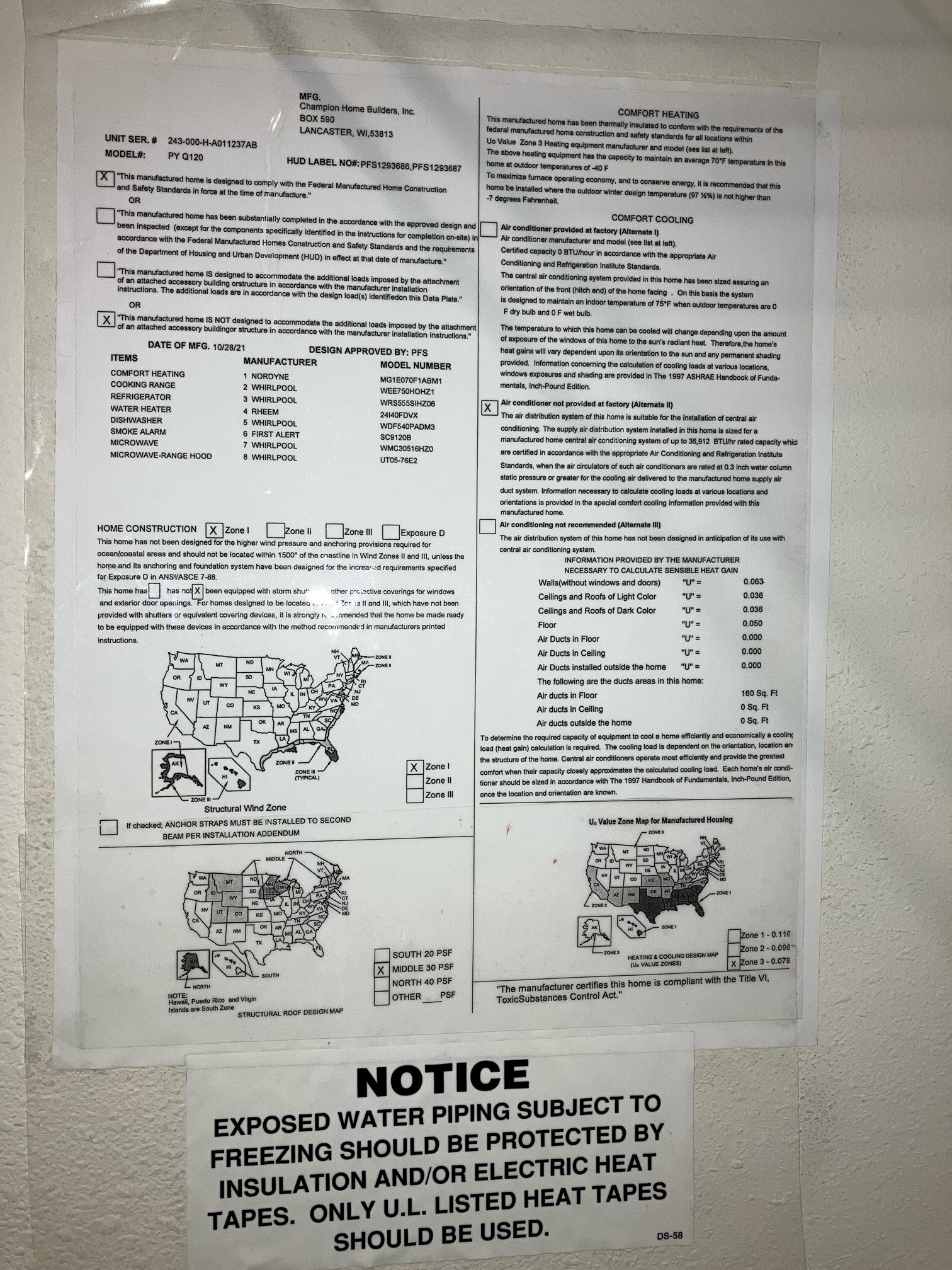
What's on a Data Plate
To understand how to read your sheet, let's walk through an actual HUD data plate example located inside a manufactured home in the Grand View community. Looking top-to-bottom and left-to-right:
Manufacturer and Location
Identifies who built the home and where—in this case, Skyline Homes in Lancaster, Wisconsin.
Certification Label Numbers
Also known as HUD tag numbers, these are stamped on metal tags affixed to the exterior of each transportable section. Single-wide homes have one number, double-wides have two.
Construction Date
Displays the exact date the home was built, which can be different from the model year. The model year is found on the Manufacturer's Certificate of Origin (MCO).
Serial Numbers
These are unique structural identifiers. For double-wides, each section shares the main serial number followed by an "A" or "B".
Factory Installed Equipment
Lists original appliances, equipment manufacturers, and serial numbers. This is critical for warranty repairs on a new home or checking if appliances were replaced in a pre-owned home.
Roof Load Zone
Homes located in northern roof load zones are built to allow for the weight of snow. Compare the roof load zone box checked with the adjacent small U.S. map to confirm that the home meets the standards of the installation location. Depending on one’s location in northern or southern Iowa, manufactured homes in the state can be built for either middle or south zones — capable of handling 20-30 pounds of snow pressure per square foot.
Wind Load Zone
Zones are designated as I, II, or III—with II and III zones constructed to withstand different levels of hurricane-force winds. Here too, compare the wind load zone checked with the adjacent map to verify construction for the proper location. Iowa doesn’t experience hurricanes, so we’re in Wind Zone I.
Comfort Cooling
If an air conditioner was installed at the factory, this information will be filled out. Otherwise, look for a separate document about any air conditioning unit(s) installed with the home.
Heating and Cooling Thermal Map
Indicates the climate zone the home was engineered for. Iowa is located in Thermal Zone 3 (the coldest zone). A home rated for a colder zone can be placed in a warmer zone, but not vice versa.
Why Your Mobile Home Data Plate Matters
Your data plate isn’t just a piece of paper — it’s proof of quality. It shows that your home was built to HUD standards for safety, durability, and energy efficiency.
Keeping it in good condition (or taking a photo for your records) helps ensure you always have quick access to your home’s essential information. Never buy a pre-owned manufactured home without this information.
How to Replace a Missing or Damaged Data Plate
If your home’s sheet is missing or unreadable, you can order a replacement certificate:
-
Visit the Institute for Building Technology and Safety (IBTS) at IBTS.org.
-
Navigate to “HUD Manufactured Home Certifications”.
-
Submit your home’s serial number, manufacturer, and address.
-
Pay the standard processing fee (typically around $50).
Ready to Find Your Next Home?
At Hames Homes, we have over 50 years of experience buying, selling, titling, and servicing manufactured homes in Eastern Iowa. Contact Clint or Curtis at (319) 377-4863 or get in touch online to view our current inventory of new and refurbished homes. We’ll match you with the right home and talk about financing, too.